The way people invest in commercial real estate is changing because buyers are no longer looking at retail, office, and residential spaces as completely separate opportunities. Instead, many investors now prefer developments where people can work, shop, dine, and spend time within one connected environment.
This shift has increased interest in mixed-use commercial projects, especially in growing urban markets such as Greater Noida. At BiigTech, we believe that understanding this model is important for every investor because it explains how different property formats can support one another and create a stronger commercial ecosystem.
Whether you are evaluating retail shops, office spaces, or studio apartments in Greater Noida, it helps to understand why mixed-use developments are becoming increasingly relevant to long-term commercial real estate investment.
What Is a Mixed-Use Commercial Project?
A mixed-use commercial project brings different types of spaces together within one development. Rather than offering only retail shops or office units, it may combine retail, workspaces, food and beverage outlets, entertainment areas, and studio apartments.
The basic idea is that each part of the development contributes to the activity of the others. For example, office professionals may visit cafés and restaurants during the day, while students, residents, and visitors may spend time in retail outlets or entertainment zones. Similarly, people staying in studio apartments benefit from having daily conveniences and workplaces nearby.
As a result, the development remains active across different hours of the day instead of depending on a single type of user. This creates a more balanced commercial environment for businesses, visitors, and investors.
Why Are Investors Choosing Mixed-Use Developments?
Commercial real estate has always depended on demand, but the way that demand is created has changed. Earlier, a standalone office building or shopping complex could rely mainly on one category of users. However, investors now pay closer attention to developments that attract several customer groups at the same time.
Consider the difference between a retail shop in an isolated commercial block and one located within a development that also includes offices, dining spaces, entertainment, and studio apartments. The second location may have a better chance of receiving regular visitor movement because people come there for different reasons throughout the day.
Therefore, mixed-use developments can offer a broader demand base. Office employees may support food and convenience retail during working hours, while residents, students, families, and visitors may contribute to activity during evenings and weekends. This varied usage can strengthen the overall commercial environment and reduce dependence on one customer segment.
Why Greater Noida Is Well Suited to This Model
Greater Noida has developed into an important education, employment, and business destination within the National Capital Region. Its growth is supported by educational institutions, corporate offices, industrial activity, technology businesses, road infrastructure, and metro connectivity.
As more people move through the city for work, study, business, and short-term stays, their needs also become more varied. They require offices, accommodation, dining, retail services, recreation, and everyday convenience. Because mixed-use commercial projects bring many of these requirements together, they fit naturally into the way Greater Noida is evolving.
In addition, the Noida-Greater Noida Expressway and the wider development around the Noida International Airport continue to influence investor interest across the region. Although infrastructure alone does not guarantee returns, better connectivity can support business movement, employment growth, and long-term commercial demand.
For this reason, investors should assess a project not only by its individual units but also by the wider economic and infrastructure ecosystem surrounding it.
How Mixed-Use Projects Support Regular Footfall
One of the main advantages of a mixed-use commercial project is its ability to attract different users at different times. Retail shops benefit when people already visit the location for work, dining, meetings, entertainment, or accommodation.
Likewise, offices become more convenient when employees have access to restaurants, cafés, banking services, and daily essentials nearby. Studio apartments can also become more appealing when tenants are able to reach workplaces, retail services, and food outlets without travelling long distances.
Since each component supports the others, the development can maintain activity across the day. Instead of relying only on shoppers, office users, or residents, a mixed-use project may attract professionals, students, entrepreneurs, families, business travellers, and local visitors.
This broader user base can help create more stable commercial activity, although actual performance will always depend on factors such as location, project planning, tenant mix, accessibility, and market demand.
What Should Investors Evaluate Before Buying?
Although the mixed-use model offers several advantages, not every project has the same potential. Therefore, investors should begin by assessing the location and the demand that already exists around it.
A well-connected project generally has a stronger foundation because customers, employees, tenants, and business owners can reach it more easily. However, connectivity should be considered together with the surrounding ecosystem, including educational institutions, corporate offices, residential communities, and established commercial activity.
Investors should also study the balance of uses within the project. A development may be more commercially sustainable when its retail, office, dining, entertainment, and accommodation components complement each other rather than compete for the same limited audience.
In addition, it is sensible to examine the project's regulatory status, development plan, accessibility, maintenance structure, unit suitability, and future infrastructure. Price is relevant, but it should not be the only factor guiding the decision.
Where BiigTech Fits Into This Changing Market
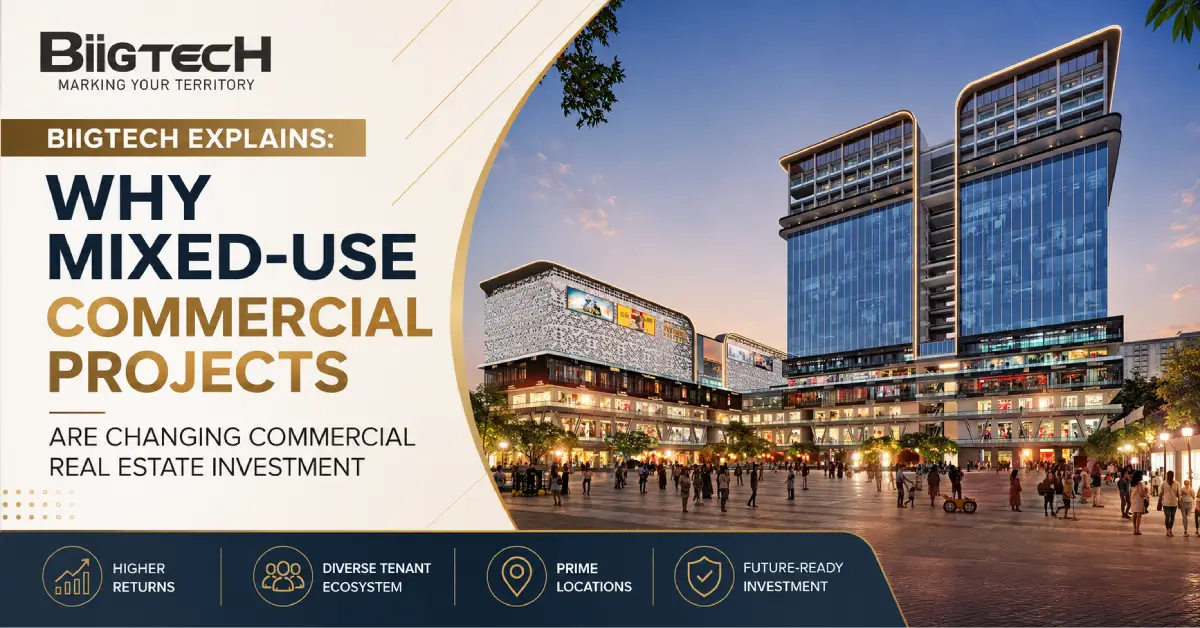
At BiigTech, we have planned our development around the way people now live, work, and use commercial spaces. Located in Knowledge Park III, Greater Noida, our project brings together office spaces, retail spaces, food court options, gaming and entertainment, and studio apartments within one integrated development.
Knowledge Park III is already associated with educational institutions and professional activity, while Greater Noida continues to expand as a wider business and infrastructure destination. Because of this surrounding ecosystem, BiigTech is positioned within an area that serves multiple user groups instead of depending on a single source of demand.
Our approach is based on the view that commercial developments should respond to everyday needs. When workplaces, retail, food, entertainment, and accommodation exist within the same environment, they can create greater convenience for users and a more connected commercial experience.
However, every buyer should still review project details, regulatory information, location conditions, and personal investment goals before making a decision.
Looking Beyond the Individual Unit
Commercial real estate investment is no longer limited to owning an isolated shop or office. Increasingly, it involves understanding how people move through a location, what services they use, and whether a development can remain relevant throughout the day.
Mixed-use commercial projects address this shift by combining several uses within one destination. As a result, they can serve different customer groups, support regular activity, and create a more complete urban environment.
At BiigTech, we believe this model reflects the changing requirements of Greater Noida. By bringing retail, office spaces, studio apartments, food, gaming, and entertainment together in Knowledge Park III, our aim is to create a development that responds to real patterns of work, business, and everyday use.
For investors exploring commercial property in Greater Noida, the key is to look beyond the unit itself and study the strength of the complete ecosystem around it. When location, connectivity, demand, and project planning work together, the investment decision becomes clearer and more informed.
Leave a Reply